
Video Relay Service (VRS)
Make and receive telephone calls using British Sign Language (BSL) with Sorenson Video Relay Service.

What Is a Video Relay Service?
What is a video relay service? A video relay service (VRS) is an interpreting service enabling a Deaf or hard-of-hearing person who uses sign language to communicate with a hearing person over the telephone.
Every video relay call involves the BSL user, a qualified video relay interpreter, and the hearing caller. The BSL user signs to the interpreter through video. The interpreter relays the signed message to the hearing person over the phone, then signs the hearing person’s spoken response back to the BSL user.
The entire conversation happens in real time, so both people can communicate back and forth naturally. Unlike text-based relay services, VRS lets BSL users communicate visually rather than typing their side of the conversation.
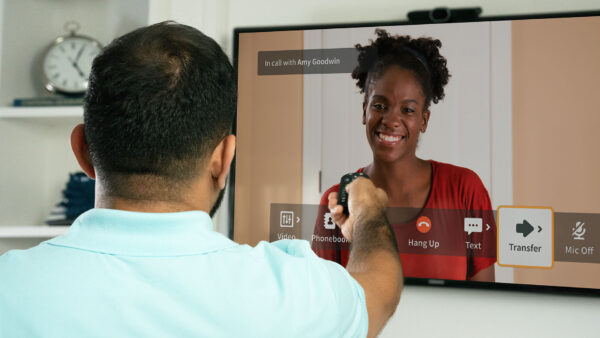
How Does Video Relay Service Work?
Understanding how does video relay service work: a VRS call connects the BSL user with a live interpreter, who facilitates the phone conversation with the hearing person in three steps:
1. Connect With a BSL Interpreter
The BSL user connects with an interpreter through video-enabled technology, allowing them to communicate visually in BSL.
2. Make or Receive a Video Relay Call
The interpreter connects with the hearing person by phone. This video relay call lets the Deaf or hard-of-hearing user communicate in BSL instead of relying on spoken or written communication.
3. Communicate in Real Time
The BSL user signs their message, and the interpreter talks to the hearing caller. The interpreter then signs the hearing person’s response back to the BSL user, for a natural, real-time conversation.
Benefits of Sorenson Video Relay Service
Sorenson video relay service offers numerous communication and accessibility advantages to BSL users:
Communicate in BSL
Communicate using BSL rather than adapting conversations to written English. Video preserves facial expressions, hand movement, and natural language subtleties.
Connect in Real Time
Live interpreting supports immediate back-and-forth communication, allowing conversations to flow naturally in each participant's preferred language.
Greater Independence
Handle telephone calls autonomously without needing hearing family members, friends, or colleagues to make calls on your behalf.
Professional BSL Interpreting
As leading video relay service providers, Sorenson combines specialized technology with experienced interpreters knowledgeable in both BSL and English nuances.
What Can You Use Video Relay Service For?
Many everyday tasks still depend on telephone communication. Sorenson VRS makes telephone access spontaneous, reliable, and direct for sign language users across the UK:
- Booking Appointments: Reserve slots with local services, mechanics, and public offices.
- Healthcare Contacts: Call GP clinics, NHS helplines, pharmacies, and dental practices.
- Banking & Utilities: Resolve account queries with your bank, energy supplier, or council.
- Customer Service: Engage directly with support desks across retail, logistics, and tech.
- Workplace Conversations: Coordinate with suppliers, interviewers, and team members by phone.
- Travel & Leisure: Confirm transit bookings, airline reservations, and holiday plans.
- Personal Calls: Stay connected with hearing friends and family members whenever you like.
Independent Calling Freedom
Direct Communication Without Intermediaries
Video Relay Service gives Deaf BSL users a secure way to manage telephone calls privately and independently, ending the necessity of relying on family members or colleagues to place calls on their behalf.
How to Use Video Relay Service
Simply open your compatible video connection, dial the desired telephone number through the relay system, and your assigned interpreter facilitates the dialogue from start to finish.
Why Choose Sorenson for Video Relay Service?
Sorenson has extensive experience developing accessible communication solutions to help Deaf and hearing people connect effortlessly.
With Sorenson Video Relay Service, interpreting expertise and communication technology make phone conversations more accessible for BSL users, with a live interpreter facilitating real-time communication with the hearing caller.
For organisations, Sorenson’s broader interpreting and accessibility expertise also reduces communication barriers and supports inclusive interactions with Deaf customers, employees, and communities.
VRS vs. VRI: What's the Difference?
Video Relay Service: Primarily focuses on standard telephone calls. A Deaf BSL user connects to an interpreter via video, and the interpreter places or receives the call to the hearing person via telephone.
Video Remote Interpreting: Provides remote interpreting for meetings, medical appointments, and conferences where participants are together in-person or on a video call. Explore VRI services →
Video Relay Service FAQs
Common questions about connecting to relay calls, compatibility, and calling options.
How does a video relay call work?
During a video relay call, a BSL user communicates with an interpreter over video while the interpreter communicates with the hearing person by phone for a natural-flowing conversation.
What do I need to use VRS?
Sorenson VRS simply requires access to a video phone. Refer to Sorenson’s current service information and support resources for further information on access and technical requirements.
What is the difference between VRS and VRI?
VRS and VRI differ in that VRS is for phone calls with BSL users and hearing callers, while VRI provides remote interpreting when the interpreter doesn’t need to be physically present. Learn more about our Video Remote Interpreting services.